

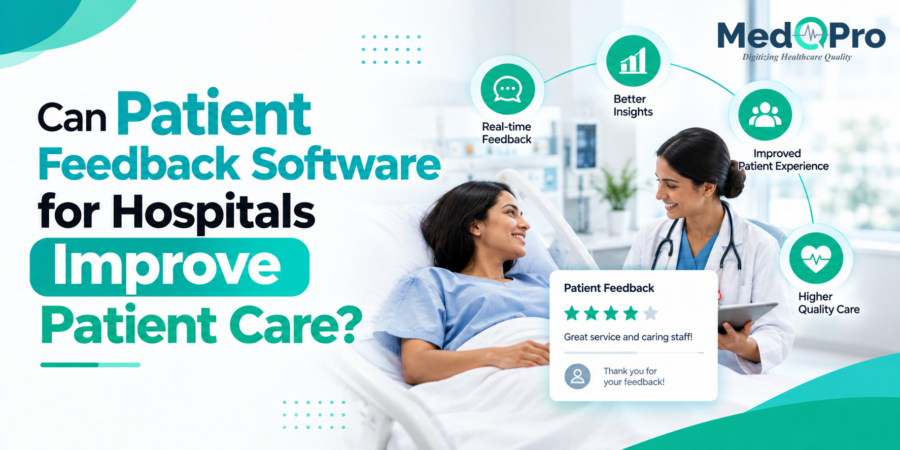
When hospitals actively listen to what the patients have to say, they receive a much more transparent picture of what is currently functioning and what requires attention. Be that as it may, good patient feedback software for hospitals makes this process much easier by bringing patient opinions into a structured set of digital systems in place of leaving scattered sets of feedback across paper forms, emails or spreadsheets.
At MedQPro, our primary goal is to indulge in simple collection of feedback. It is also about assisting hospitals in turning patient experiences into useful sets of quality insights that can further drive better services and continued improvement.
Table of Contents
- Does patient feedback software boost care outcomes?
- Can feedback tools reduce hospital readmission rates?
- How does real-time feedback improve patient safety?
Does patient feedback software boost care outcomes?
At MedQPro, we place prime importance on the feedback of patients and hospitals can turn feedback into spontaneous action which can otherwise go unnoticed and foster wider communication gaps. Likewise, patient feedback software to improve hospital care assists the teams to organise these key sets of responses and even recognise patterns and potentially decide where improvisation is needed.
| Without Digitised Feedback System | With Patient Feedback Software |
| Feedback can remain scattered that too, across spreadsheets and even forms | Feedback can be spontaneously organised in one digital system |
| The recurring patient concerns can be complex to spot | Teams can actively recognise common trends in an easier manner |
| Follow-up might rely on manual coordination | Relevant set of concerns can thus be directed to responsible teams |
| Patient experience data may be reviewed in an occasional manner | Feedback prospect can assist ongoing patient satisfaction management |
| Quality teams have limited visibility into the core feedback patterns | A structured set of insights can assist quality improvement decisions |
Thus the difference is not simply about collecting more sets of feedback but rather about making the feedback usable. Be that as it may, when hospitals perceive what patients are experiencing repeatedly, they develop a much stronger base for reviewing processes and subsequently build upon meaningful improvisation.
(Also Read: Switching Patient Experience with Smart Feedback Systems in India)
Can feedback tools reduce hospital readmission rates?
At MedQPro, we assist healthcare organisations with a quality focused approach backed by accreditation process and in this context, the feedback tools stand effective in aiding hospitals to address experience related issues and might reduce readmission rates. However, the feedback system alone is not sufficient. The ideal value comes into play as in what a hospital does and what core information it receives.
Here are the ways in which the process works:
- Collecting patient feedback: Patients can actively share concerns about discharge and even core experience and medications and even communication
- Recognise recurring concerns: In this ground, quality teams can proactively review upon responses and look for potential patterns such as for instance; patients repeatedly reporting about the lack of clarity in discharge instructions
- Investigating issue: Relevant team can effectively test as in why the issue occurred and spontaneously determine whether shifts are needed
- Taking corrective action: Hospitals enhance patient education and even enhancing follow up communication
- Monitoring results: Consistent reviewing of feedback and quality indicators stand effective to demonstrate as in whether changes are bringing desired outcome
Thus these key steps make hospital patient experience as a useful source of information. The prime goal is to uncover respective areas where care journey prospects can be enhanced.
How does real-time feedback improve patient safety?
At MedQPro, our real-time patient feedback system for hospitals aid in noticing concerns sooner. In place of waiting for a quarter or month to explore upon recurring issues, teams can explicitly receive and review feedback closer to when a core patient’s experience actually happened.
The Pros:
- Fast paced visibility into the respective patient concerns
- More easy recognition of recurring set of experience issues
- Better assistance for quality improvement decisions
- Much more organised feedback records
The Cons
- Not each patient offers feedback
- Complaint does not automatically demonstrate upon a safety incident
- Feedback still requires appropriate action and human review
This is the prime reason as to why patient feedback tools for improving patient safety should work side by side with the wider quality and core risk management procedure. In this ground, we assist multiple hospital quality functions together and thus assisting healthcare organisation to take a much more connected approach towards improvement.
Turn Patient Feedback Into Hospital’s Next Quality Improvement Breakthrough With MedQPro
A patient’s feedback should not exclusively disappear into a survey database and just never be seen again.At MedQPro, we actively help healthcare organisations to digitise quality workflows and support continued improvement.
Are you ready to make the patient feedback much more meaningful as your core quality strategy? Contact MedQPro and get in touch with our team for more software demonstrations. The real set of value primarily comes from developing an understanding as in what patients are saying and simultaneously utilising those key insights to enhance the way care is delivered.
FAQs
Why is feedback from patients essential for quality departments of hospitals?
Patient feedback enables the quality department to learn how patients undergo the healthcare process and see data from an operational and clinical perspective.
Is it possible for patient feedback to contain positive reviews?
Yes. Positive reviews identify patient experience aspects that are effective, thus helping hospitals know what to continue doing successfully.
Should hospitals save patient feedback data?
Organised records allow hospitals to keep track of various trends, make connections between trends over different periods, and assist with the overall quality management process in hospitals.