
Can Hospital QMS Software Digitise Quality Records?

Can Hospital QMS Software Digitise Quality Records?

Within most of the hospitals, the core quality management system stands as a collection of good intentions which are being held together with manual effort.

Quick Summary: A hospital QMS software aids in digitising the quality records through centralising policies backed by standard operating procedures, audit reports and even incident documentation within a structured digital systemology. At MedQPro, we effectively combine documentation management with quality workflows to assist core healthcare teams in reducing paperwork and improving access to essential records. 

Key takeaway: Digitised documentation can enhance record control and corresponding audit readiness; however, NABH compliance relies on meeting applicable standards and not just simple adoption of software. 

Table of Contents 

  • How does hospital QMS software replace paper quality records?
  • Is digital quality documentation NABH compliant?
  • How secure are digitised hospital quality records? 

How does hospital QMS software replace paper quality records?

At MedQPro, the QMS software supports a digital level of document management while assisting hospitals to organise, classify, share, and even secure and archive documents and hence aid in replacing paper quality records. Be that as it may, a Hospital Quality Management System brings documentation procedures into a much more structured ecology while reducing reliance on a scattered set of files and manual tracking. 

For example, when a hospital updates about an infection control SOP, it is a digital workflow which thereby assists in helping the staff to manage the revised document and its key distribution. 

The key advantages involve:

  • Centralised documentation: Organising key policies along with quality records and SOPs 
  • Document control: Managing document revisions along with approvals through a defined set of workflows 
  • Faster retrieval: Locating records in a much more efficient manner during internal audits
  • Driving better coordination: Tracking documentation, responsibilities, and pending tasks 

Thus, these key capabilities assist quality teams to maintain a consistent range of documentation practices while supporting accreditation preparation. 

Also Read: What Are the Benefits of Healthcare QMS Software?

Is digital quality documentation NABH compliant?

At MedQPro, a digital quality documentation can actively support the NABH accreditation through an action of helping the hospitals to organise the records and even standerdise quality workflows. According to NABH, the respective hospital management teams view it as a key tool to implement a structured process starting from clinical documentation to core waste management. 

However, electronic storage at a single level does not primarily guarantee compliance. Hospitals are required to follow applicable NABH requirements for document control to foster confidentiality and ensure record integrity, access and retention. A Hospital QMS software for paperless quality documentation can assist these key processes. 

Needs  How digitised documentation assists 
Document control  Organise SOPs and policies 
Preparation of audit  Making supporting evidence much easier to retrieve 
Record intention  Supporting systematised record management 

Hospitals should thus verify against the applicable NABH standards and ensure that their key implementation meets the needs. 

How secure are digitised hospital quality records? 

At MedQPro, a digitised documentation assists in organising upon the quality records, where however hospitals should priorly verify particular security features which are being available in their key implementation and thus how secure are the respective quality records of hospitals at digital level varies. Further, a secure Healthcare Quality Documentation Software should safeguard sensitive information while actively allowing authorised staff to access necessary records. 

Hospitals should further assess role-based permissions backed by user authentication and even document change tracking, audit trails, encryption and secure data transmission before selecting any specific solution. 

These respective safeguards thus assist in protecting record integrity and support responsible information management. 

Digitise Quality Management with MedQPro

MedQPro is a platform that combines documentation, auditing, incident management, and risk management workflows in one system. Contact MedQPro and get to know further what Hospital QMS software can do for your hospital, whether it helps sort different quality records, lessen the amount of manual documentation, as well as prepare your company for accreditation.

FAQs 

What is the implementation time for hospital software?

The implementation time is determined by the hospital size, internal processes, the total number of modules being implemented, data migration, and employee training.

Can the QMS be used to keep track of quality indicators?

Definitely, the software helps the quality team collect data, analyse the data, and find areas for enhancement.

Is it possible for a hospital QMS to help with an incident investigation?

It is true that it has many features that assist employees in completing and tracking incidents as well as corrective actions related to investigations.
Can Healthcare Quality Management Software Simplify JCI Audits

Can Healthcare Quality Management Software Simplify JCI Audits?

The respective JCI accreditation requires hospitals to maintain consistency in core quality procedures, backed by an accurate range of documentation and evidence of ongoing adherence to compliance, that too across multiple departments. Be that as it may, at MedQPro, the corresponding healthcare quality management software can aid in the simplification of JCI standards. Thus, in place of relying on disconnected spreadsheets and manual records, hospitals can make effective use of a centralised system to organise quality procedures and maintain wider visibility over readiness. 

For hospitals that are working towards accreditation, it is the right Healthcare QMS Software that can foster consistent monitoring while assisting quality teams to recognise gaps and even assign new responsibilities and maintain the records that are needed during reviews. 

Table of Contents 

  • Can healthcare QMS software track JCI standards compliance?
  • What features help hospitals prepare for JCI accreditation?
  • Is healthcare quality software worth it for JCI readiness? 

Can healthcare QMS software track JCI standards compliance?

At MedQPro, we demonstrate that QMS software for healthcare can assist hospitals in organising and monitoring activities primarily related to JCI standards of compliance, including digitised quality workflows, audits, incidents, and risk management. While the software does not actively replace the work that is needed to meet the respective accreditation standards, it can further give quality teams a much more systematised way to manage evidence, follow up on actions, and foster ongoing improvement. 

Thus, healthcare quality management software for JCI accreditation can actively assist teams in moving away from a scattered range of records while establishing a much more traceable approach to drive quality management. This aspect can thus make it quite feasible to recognise pending activities and maintain core accountability across departments. 

Also Read: How Does Hospital QMS Improve Patient Safety?

What features help hospitals prepare for JCI accreditation?

At MedQPro, JCI Accreditation Software can actively assist preparation by connecting multiple quality and accreditation-related procedures under one central platform. Here are the specific attributes that can assist hospitals, including: 

  • Management of Quality Assurance Audits for planning and directing audits 
  • Management of Performance Indicators for monitoring performance indicators 
  • Management of Compliance with Medical Records for systematic compliance oversights
  • Management of Documentation for monitoring policies and procedures during their life cycle 
  • Management of Simulated Exercises for management of exercises from start to end 
  • Automated notifications and workflow assignments to enable timely action
  • Mobile capability for reporting, investigating, assessing, and approving  

Thus, these respective capabilities can assist quality teams to maintain a more organised accreditation workflow in place of managing each and every activity in a manual manner. 

Is healthcare quality software worth it for JCI readiness? 

At MedQPro, healthcare quality software can be of prime value for JCI readiness when hospitals need to actively coordinate a range of quality activities, maintain and monitor performance, and enhance overall accountability across teams. 

JCI readiness issue  How a digitised QMS can assist
Multiple levels of quality activities  Bringing workflows into one key platform 
Preparation of audit  Supporting a structured level of audit management 
Control of document  Helping in managing SOPs and policies 
Incident follow-up  Enabling core reporting and tracking 
Monitoring of the risk factor  Supporting risk identification and mitigation 

Thus, Healthcare QMS software for JCI standards compliance can thus serve as an effective level of operational support system rather than simply acting as an explicit document repository. 

Make JCI Readiness More Organised With MedQPro 

Achieving Joint Commission International (JCI) accreditation requires sustained focus on various aspects such as quality, safety, documentation, risk, audits, and improvement. If hospitals wish to streamline these processes, healthcare quality management software can be of great use.

Using MedQPro provides healthcare facilities with a structured approach to accreditation management since it features integrated workflows, reporting capabilities, documentation controls, and mobile access, among others.

Need a way to make your hospital’s quality and accreditation processes more efficient? Consider and contact MedQPro for your quality management needs.

FAQs 

Can quality teams use QMS workflows from outside the office?

Yes. Mobile-friendly solutions are available for users to file, investigate, evaluate, authorise and delegate their tasks when away from the office.

Is the QMS capable of managing incidents?

The answer is yes. Incident workflow management allows managing the flow of incidents, assigning necessary activities, and maintaining the efficiency of the incident resolution process.

Does QMS help with the process of continuous improvement?

Yes. Companies can use digital solutions to continuously improve the quality of their processes by analysing KPIs, audits, incidents, risks, and corrective actions.

Can Patient Feedback Software for Hospitals Improve Patient Care

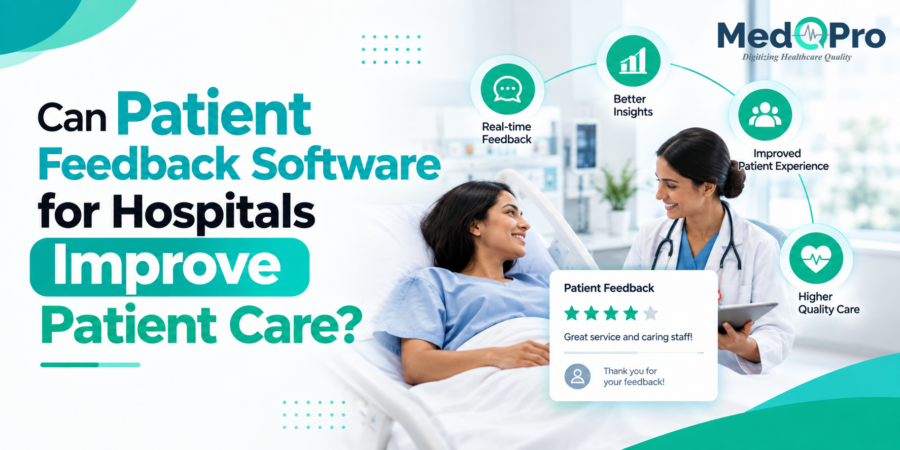
Can Patient Feedback Software for Hospitals Improve Patient Care?

When hospitals actively listen to what the patients have to say, they receive a much more transparent picture of what is currently functioning and what requires attention. Be that as it may, good patient feedback software for hospitals makes this process much easier by bringing patient opinions into a structured set of digital systems in place of leaving scattered sets of feedback across paper forms, emails or spreadsheets. 

At MedQPro, our primary goal is to indulge in simple collection of feedback. It is also about assisting hospitals in turning patient experiences into useful sets of quality insights that can further drive better services and continued improvement. 

Table of Contents 

  • Does patient feedback software boost care outcomes?
  • Can feedback tools reduce hospital readmission rates?
  • How does real-time feedback improve patient safety?

Does patient feedback software boost care outcomes?

At MedQPro, we place prime importance on the feedback of patients and hospitals can turn feedback into spontaneous action which can otherwise go unnoticed and foster wider communication gaps. Likewise, patient feedback software to improve hospital care assists the teams to organise these key sets of responses and even recognise patterns and potentially decide where improvisation is needed. 


Without Digitised Feedback System  With Patient Feedback Software 
Feedback can remain scattered that too, across spreadsheets and even forms  Feedback can be spontaneously organised in one digital system 
The recurring patient concerns can be complex to spot  Teams can actively recognise common trends in an easier manner 
Follow-up might rely on manual coordination  Relevant set of concerns can thus be directed to responsible teams 
Patient experience data may be reviewed in an occasional manner  Feedback prospect can assist ongoing patient satisfaction management
Quality teams have limited visibility into the core feedback patterns  A structured set of insights can assist quality improvement decisions 


Thus the difference is not simply about collecting more sets of feedback but rather about making the feedback usable. Be that as it may, when hospitals perceive what patients are experiencing repeatedly, they develop a much stronger base for reviewing processes and subsequently build upon meaningful improvisation. 

(Also Read: Switching Patient Experience with Smart Feedback Systems in India)

Can feedback tools reduce hospital readmission rates?

At MedQPro, we assist healthcare organisations with a quality focused approach backed by accreditation process and in this context, the feedback tools stand effective in aiding hospitals to address experience related issues and might reduce readmission rates. However, the feedback system alone is not sufficient. The ideal value comes into play as in what a hospital does and what core information it receives. 

Here are the ways in which the process works: 

  1. Collecting patient feedback: Patients can actively share concerns about discharge and even core experience and medications and even communication 
  2. Recognise recurring concerns: In this ground, quality teams can proactively review upon responses and look for potential patterns such as for instance; patients repeatedly reporting about the lack of clarity in discharge instructions 
  3. Investigating issue: Relevant team can effectively test as in why the issue occurred and spontaneously determine whether shifts are needed 
  4. Taking corrective action: Hospitals enhance patient education and even enhancing follow up communication 
  5. Monitoring results: Consistent reviewing of feedback and quality indicators stand effective to demonstrate as in whether changes are bringing desired outcome

Thus these key steps make hospital patient experience as a useful source of information. The prime goal is to uncover respective areas where care journey prospects can be enhanced. 

How does real-time feedback improve patient safety?

At MedQPro, our real-time patient feedback system for hospitals  aid in noticing concerns sooner. In place of waiting for a quarter or month to explore upon recurring issues, teams can explicitly receive and review feedback closer to when a core patient’s experience actually happened. 

The Pros: 

  • Fast paced visibility into the respective patient concerns 
  • More easy recognition of recurring set of experience issues 
  • Better assistance for quality improvement decisions 
  • Much more organised feedback records 

The Cons 

  • Not each patient offers feedback 
  • Complaint does not automatically demonstrate upon a safety incident 
  • Feedback still requires appropriate action and human review 

This is the prime reason as to why patient feedback tools for improving patient safety should work side by side with the wider quality and core risk management procedure. In this ground, we assist multiple hospital quality functions together and thus assisting healthcare organisation to take a much more connected approach towards improvement. 

Turn Patient Feedback Into Hospital’s Next Quality Improvement Breakthrough With MedQPro

A patient’s feedback should not exclusively disappear into a survey database and just never be seen again.At MedQPro, we actively help healthcare organisations to digitise quality workflows and support continued improvement.

 Are you ready to make the patient feedback much more meaningful as your core quality strategy? Contact MedQPro and get in touch with our team for more software demonstrations.  The real set of value primarily comes from developing an understanding as in what patients are saying and simultaneously utilising those key insights to enhance the way care is delivered. 

FAQs 

Why is feedback from patients essential for quality departments of hospitals?

Patient feedback enables the quality department to learn how patients undergo the healthcare process and see data from an operational and clinical perspective.

Is it possible for patient feedback to contain positive reviews?

Yes. Positive reviews identify patient experience aspects that are effective, thus helping hospitals know what to continue doing successfully.

Should hospitals save patient feedback data?

Organised records allow hospitals to keep track of various trends, make connections between trends over different periods, and assist with the overall quality management process in hospitals.

What Are the Benefits of Healthcare QMS Software?

Training management within a hospital is not just a simple task. At this stage, a Hospital Quality Management Software followed by respective competency tracking and even credentialing, audits, and documentation, all come together within a structured, digitized systemology. The result involves much better visibility, backed by feasible follow-up and an even more consistent level of quality processes.

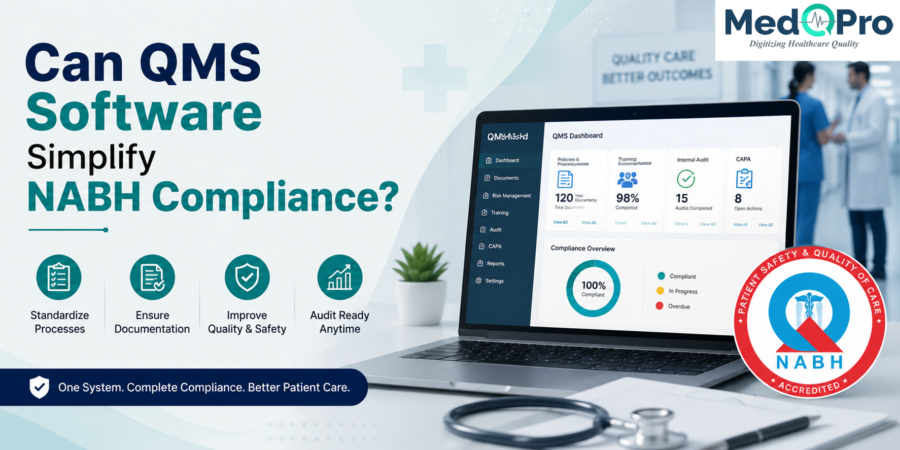
Can QMS Software Simplify NABH Compliance?

As the first JCI- and NABH-compliant healthcare QMS Solution, MedQPro is being pertinently designed with the corresponding expertise of leading JCI and NABH accreditation consultants. Thus, the respective QMS software can aid in simplifying NABH compliance of the NABH through an act of digitising the quality workflows, along with documentation and even incident management, audits, indicators, and corrective actions under one platform.

Page 1 of 13

© Copyright 2021 All Rights Reserved